HCC testing that works for patients

See why the Oncoguard® Liver test is simple and convenient.

The Oncoguard® Liver test is a sophisticated, yet simple, single blood test delivering high sensitivity and specificity to aid consistent and reliable hepatocellular carcinoma (HCC) detection.

The convenience of accurate blood-based testing helps streamline HCC testing, making it easier for patients to follow through with their care.

Laboratory staff in protective gear handling sample racks.

A unique set of markers clarifies the information

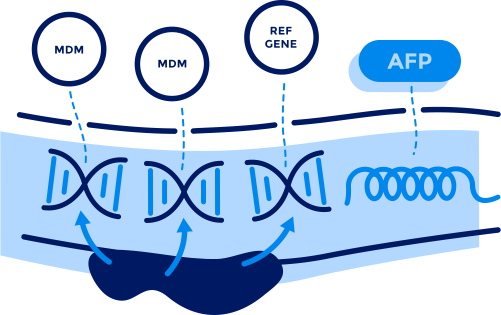
The Oncoguard® Liver test analyzes plasma for methylated DNA markers (MDMs) and serum for the alpha-fetoprotein (AFP).

Methylated DNA markers are a class of biomarkers that may demonstrate aberrant methylation of gene promoter regions, which is common and widespread in HCC cells, even in early stages of the disease.1

High levels of AFP have been shown to be associated with liver diseases, including HCC,2 which is why AFP is the most widely used serological marker to help establish an HCC diagnosis.3

This unique combination of DNA and protein biomarkers employed in the Oncoguard® Liver test exhibits an additive association with HCC.

Illustration conveying methylated DNA markers (MDM), a reference gene, and alpha-fetoprotein (AFP).

Sophisticated analysis
Actionable results

The Oncoguard® Liver test uses a sophisticated algorithm combining the patient’s biological sex with results from the analysis of AFP and the MDMs to generate an actionable qualitative result.


Clinical Performance

Robustly designed for early detection of HCC in real-world settings

The Oncoguard® Liver test was designed to deliver a high level of accuracy with enhanced sensitivity for detection of early-stage HCC.4

Gloved hands processing sample plates in a laboratory.

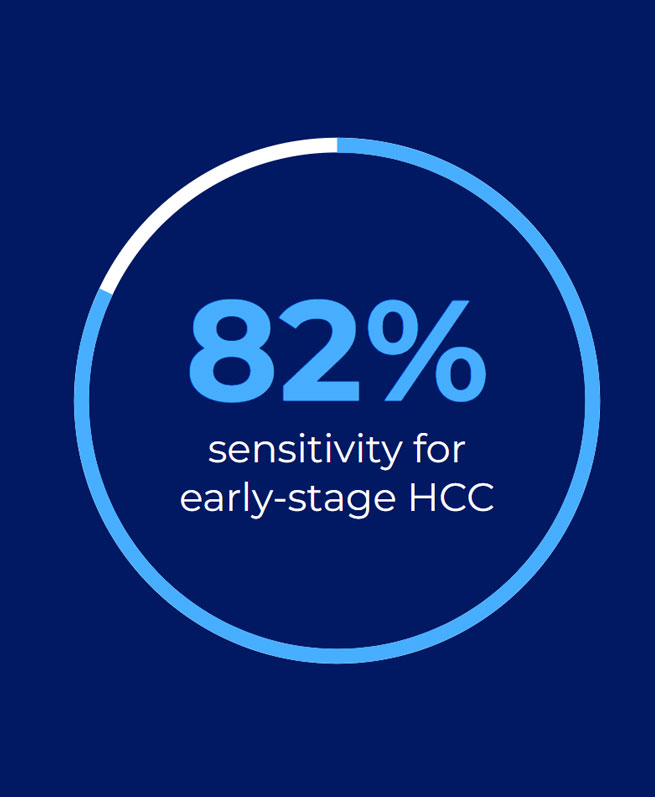
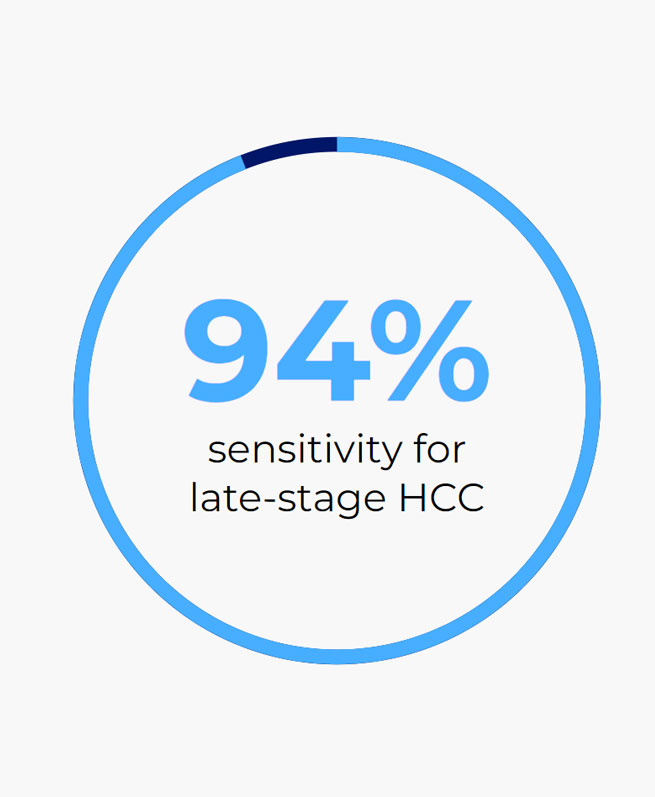
At 87% specificity, the Oncoguard® Liver test demonstrates:

Statistic displaying that Oncoguard® Liver has 82% sensitivity for early-stage HCC.
Statistic displaying that Oncoguard® Liver has 94% sensitivity for late-stage HCC.

Validation of the test demonstrated high performance. AFP alone displayed a sensitivity of 40%, while the Oncoguard® Liver test demonstrated 82% sensitivity in detecting early-stage HCC.4

Localized stage

exs-lvr-icon-liver-localized

60-80%

Five-year survival rate for those who are diagnosed at an early stage and undergo curative therapy5-8

Regional stage
exs-lvr-icon-liver-regional

Distant stage

exs-lvr-icon-liver-distant

3-12%

Five-year survival rate for those diagnosed at late stage8

Scientific Rigor

Getting ahead of cancer is crucial, no matter where people are in their cancer journey

From earlier cancer detection to treatment guidance and monitoring, we want to help people get the answers they need to make more informed decisions across the cancer continuum.

With this goal in mind, Exact Sciences undertook a scientifically rigorous development path to address the unmet need for reliable early detection of hepatocellular carcinoma (HCC), ultimately introducing the OncoguardTM Liver test. While innovative in its own right, the OncoguardTM Liver test is part of a much larger, more comprehensive approach to HCC detection—an approach that improves access by offering simple and convenient blood collection, performance that may improve upon the current standard of care, and a tailored Patient Engagement Program that may improve patient adherence to routine HCC testing.

GettyImages-638646884-resize

Robust scientific development


In collaboration with leading experts at Mayo Clinic, Exact Sciences utilized a clinical development platform robustly designed to provide reliable results that translate into real-world clinical practice, giving clinicians enhanced confidence in their HCC testing.

One of the largest HCC case-control studies supported the development and validation of the Oncoguard® Liver test. The case-control study was designed with input from leading hepatologists and followed robust enrollment criteria informed by HCC guidelines.9

exs-lvr-icon-sites

Included >70 sites across the United States, European Union, and Asia

exs-lvr-icon-hcc-cases

Yielded 1400 disease etiology-matched HCC surveillance controls and 700 clinically diagnosed HCC cases

Unique cohorts from this study were used throughout the marker selection, algorithm setting, and clinical validation stages of development.

The Oncoguard® Liver test development journey4,10-12

exs-lvr-Icon-Biomarker
1

Biomarker discovery

Over 300 biomarkers from tissue and plasma identified

exs-lvr-Icon-Early-Stage-Detection
2

Marker selection

10 methlylated DNA markers (MDMs) and multiple proteins identified and assessed

exs-lvr-icon-Algorithm
3

Algorithm setting

Algorithm using 3 methylated markers + AFP + Sex was identified to deliver high sensitivity for early-stage HCC

exs-lvr-Icon-Validation
4

Assay clinical validation

Locked algorithm used to independently validate of clinical performance of the Oncoguard® Liver test

The Oncoguard® Liver test consistently demonstrated high sensitivity for early-stage HCC detection throughout all stages of development. Final performance characteristics were established by evaluating a panel of blood specimens from this large cohort, leading to a blood-based test that can detect HCC at any stage—with strong sensitivity at early stages when it matters most—and maintains performance across disease etiologies.

Adding to the Workflow

A simplified testing pathway for most patients

The Oncoguard® Liver test is a simple, yet sophisticated blood test offering a streamlined approach to HCC testing that can be integrated into your clinical workflow where it fits best for you. It delivers easy-to-interpret, actionable information in a single assessment.

The Oncoguard® Liver test is designed to be used in the clinical care pathway for at-risk patients.

exs-lvr-icon-patients-mf

Patients at risk for HCC
With Cirrhosis
Hepatitis B, C
Alcohol
Genetic hemochromatosis
Non-alcoholic fatty liver disease (NAFLD)
Stage 4 primary biliary cholangitis
Alpha-1-antitrypsin deficiency
Other causes of cirrhosis
Without Cirrhosis
Hepatitis B carriers (select)
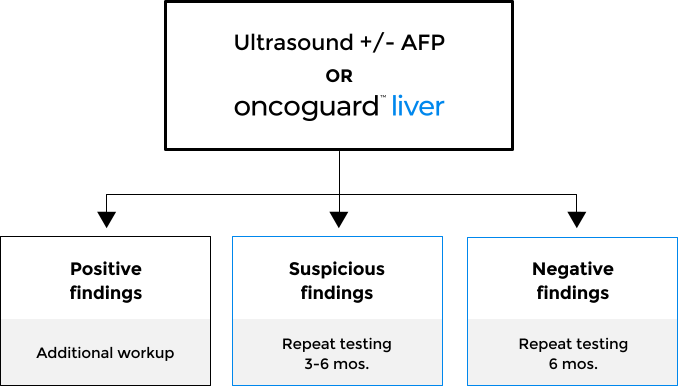
HCC testing
Flowchart showing the HCC testing pathway: getting an ultrasound with or without AFP - or receiving the Oncoguard® Liver Test - leads to positive findings (additional workup), suspicious findings (repeat testing in 3-6 months), or negative findings (repeat testing in 6 months).


Adapted from AASLD guideline13

Please note that the Oncoguard® Liver test is not currently recommended as part of the AASLD guideline.

The Oncoguard® Liver test is intended for the qualitative detection of biomarkers associated with HCC and is indicated as an aid in the detection of HCC for adults with liver cirrhosis and/or chronic hepatitis B (HBV) who are at risk for HCC.

Chris-Conroy-Photography-2429-small

Consistency

A blood-based biomarker test like the Oncoguard® Liver test introduces a level of clarity and consistency you may not see with ultrasound assessments. Ultrasound sensitivity is often variable based on operator, equipment, and the patient’s overall morphology.13,14 Blood-based assessment offers consistency without concerns about patient weight, operator or equipment variability.

Convenience

The Oncoguard® Liver test requires a simple blood collection, enabling HCC testing from a single location. The convenience of a blood-based test may minimize the logistical challenges often encountered with traditional imaging procedures, helping more patients follow through with their care.

Healthcare provider preparing to draw blood from a patient's arm.

Orders & Results

Oncoguard® Liver test ordering

The Oncoguard® Liver test offers the convenience of one simple blood collection that can be performed in your office or an affiliated laboratory. All you need to have on hand at the blood collection site is the Exact Sciences Blood Collection Kit and the Oncoguard® Liver test Requisition Form (RF) if you’re ordering tests manually.

Specimens are collected using the Exact Sciences Blood Collection Kit (kit).
Icon representing the Oncoguard® Liver test.

Convenient ordering processes that work with your workflow

The Oncoguard® Liver test can be ordered in one of two ways:

exs-lvr-electronic-ordering
More detailed information on electronic ordering through EpicCare® LinkTM can be found in the EpicCare® LinkTM Welcome Guide in the Training and Additional Resources section within EpicCare® Link.TM
exs-lvr-Icon-PC-Arrow
Download a fillable PDF of the Requisition Form, Statement of Medical Necessity, and ABN form from the Resources page.
exs-lvr-Icon-Customer-Care
Our Customer Care Center can help you with your supply orders for Blood Collection Kits, Requisition Forms, Labels and setting up an EpicCare® LinkTM account.
See the Order Supplies section for more details »


Some health plans may require prior authorization for the Oncoguard® Liver test. Prior authorization should be completed prior to specimen collection. A signed Advance Beneficiary Notice of Noncoverage (ABN) is required for standard Medicare plans.

Oncoguard® Liver test results are generated in a format that’s easy to read and understand and will typically be:

  • Available within a week from the specimens being received in our laboratory
  • Available in a patient’s chart in EpicCare® LinkTM for those providers with an EpicCare® LinkTM account, or
  • Sent via secure fax using the secure fax number included on the Order Requisition Form
exs-lvr-icon-negative-result

Negative result

A negative test result indicates a lower likelihood of the presence of HCC. When a negative result is obtained, a 3- to 6-month surveillance cadence is suggested.

exs-lvr-icon-positive-result

High result

A high test result may indicate the presence of HCC. When a positive result is reported, additional clinical assessment to confirm the presence of HCC is suggested (e.g., diagnostic imaging procedures).

In rare instances, a technical failure or insufficient clinical material in the sample yields an invalid result.

False positive and false negative results are possible with the Oncoguard® Liver test. In the clinical lab validation study, the false positive rate was 13% and the false negative rate was 12%.4

The Oncoguard® Liver test is a simple, yet sophisticated blood test that delivers actionable information with a single assessment.

Illustration of a liver with checkmarks, representing actionable test results.

Insurance & Billing

Coverage overview

Exact Sciences recognizes that coverage for hepatocellular carcinoma (HCC) testing is vital to ensuring that all patients have access to the quality information about their health that they deserve.

We are working with payors on an ongoing basis to gain coverage, and more information will be provided as coverage expands.

Customer service representative sitting in an office setting and smiling while pressing a headset to his ear.

Financial support

As Exact Sciences continues efforts to ensure coverage for the Oncoguard® Liver test, we also recognize that early-stage detection can't wait. We want to help patients stay on course with testing by offering:

  • Flexible payment plans
  • A financial assistance program, based on eligibility
  • Patient-assisted insurance appeals
Customer service representative wearing a headset in an office setting, turning and smiling at the camera.

We are here to help ensure access to quality HCC testing with the Oncoguard® Liver solution.

Contact the Customer Care Center at 1-844-870-8870 or fill out a form to request a visit with a representative.

References: 1. Oussalah A, Rischer S, Bensenane M, et al. Plasma mSEPT9: a novel circulating cell-free DNA-based epigenetic biomarker to diagnose hepatocellular carcinoma. EBioMedicine. 2018;30:138-147. 2. Kew M. Alpha-fetoprotein in primary liver cancer and other diseases. Gut. 1974;15(10):814-821. 3. Bai D-S, Zhang C, Chen P, Jin S-J, Jiang G-Q. The prognostic correlation of AFP level at diagnosis with pathological grade, progression, and survival of patients with hepatocellular carcinoma. Sci Rep. 2017;7(1):12870. 4. Chalasani NP, Porter K, Bhattacharya A, Book AJ, Neis BM, Xiong KM, Ramasubramanian TS, Edwards V DK, Chen I, Johnson S, Roberts LR, Kisiel JB, Reddy KR, Singal AG, Olson MC, Bruinsma JJ, Validation of a novel multi-target blood test shows high sensitivity to detect early-stage hepatocellular carcinoma, Clinical Gastroenterology and Hepatology (2021) 5. Mehta N, Guy J, Frenette CT, Dodge JL, Osorio RW, Minteer WB, Roberts JP, Yao FY. Excellent Outcomes of Liver Transplantation Following Down-Staging of Hepatocellular Carcinoma to Within Milan Criteria: A Multicenter Study. Clin Gastroenterol Hepatol. 2018 Jun;16(6):955-964. 6. Tabrizian P, Holzner ML, Mehta N, Halazun K, Agopian VG, Yao F, Busuttil RW, Roberts J, Emond JC, Samstein B, Brown RS Jr, Najjar M, Chapman WC, Doyle MM, Florman SS, Schwartz ME, Llovet JM. Ten-Year Outcomes of Liver Transplant and Downstaging for Hepatocellular Carcinoma. JAMA Surg. 2022 Sep 1;157(9):779-788. 7. Zhang K, Chen R, Gong X, Gao Y. Survival outcomes of liver transplantation versus liver resection among patients with hepatocellular carcinoma: A SEER-based longitudinal study. J Formos Med Assoc. 2019 Apr;118(4):790-796. 8. Liver cancer survival rates. American Cancer Society. Revised February 11, 2025. Accessed June 3, 2026. https://www.cancer.org/cancer/types/liver-cancer/detection-diagnosis-staging/survival-rates.html 9. Exact Sciences Corporation. Blood sample collection to evaluate biomarkers for hepatocellular carcinoma. NLM identifier: NCT03628651. Accessed April 18, 2024. http://www.clinicaltrials.gov/ct2/show/NCT03628651. 10. Kisiel JB, Dukek BA, Kanipakam RVSR, et al. Hepatocellular carcinoma detection by plasma methylated DNA: discovery, phase I pilot, and phase II clinical validation. Hepatology. 2019;69(3):1180-1192. 11. Chalasani NP, Ramasubramanian TS, Bhattacharya A, et al. Combined methylated DNA and protein markers: an accurate blood-based test for early-stage detection of hepatocellular carcinoma. Abstract presented at: the American Association for the Study of Liver Disease; November 8-12, 2019; Boston, MA. 12. Chalasani NP, Bhattacharya A, Book A, et al. Algorithm for blood-based panel of methylated DNA and protein markers to detect early-stage hepatocellular carcinoma with high specificity. J Clin Oncol. 2020;38(15);4577-4577. 13. Marrero JA, Kulik LM, Sirlin CB, et al. Diagnosis, Staging, and Management of Hepatocellular Carcinoma: 2018 Practice Guidance by the American Association for the Study of Liver Diseases. Hepatology. 2018;68:723-750. 14. Simmons O, Fetzer DT, Yokoo T, et al. Predictors of adequate ultrasound quality for hepatocellular carcinoma surveillance in patients with cirrhosis. Aliment Pharmacol Ther. 2017;45(1):169-177.